
Looking for 360 View?

You're in the right place. 360 View is now part of Abrigo.
Read the press release

5 Ways suspicious activity monitoring services can bring staff relief

Terri Luttrell, CAMS-Audit, CFCS
January 21, 2025
0 min read

Taking a vacation is often a well-deserved break, but for financial crime professionals, it can trigger significant stress. Fraud and AML/CFT suspicious activity monitoring is a cornerstone of any AML program and a critical part of a financial institution’s safety and soundness. However, compliance departments are frequently understaffed. Unexpected disruptions like turnover or family leave can exacerbate an already challenging workload for staff.  

The situation becomes even more complex when seasonality or other events arise, such as: 

  • An AML or fraud staff member takes extended leave or has an unplanned exit from the team;  
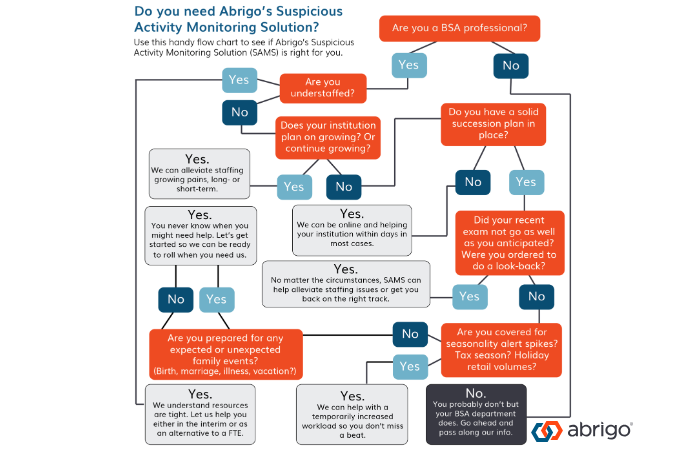
  • An increased volume of specific suspicious activity alerts, such as during tax season or holiday retail months; 
  • A regulator requires a look-back of alerts to identify potential missed suspicious activity. 

How would your institution manage this additional workload while maintaining compliance with daily deadlines? Do you have a backup AML staffing plan that ensures all regulatory requirements are met?  

These challenges can feel overwhelming, but hitting the panic button is unnecessary. Abrigo’s Suspicious Activity Monitoring Services (SAMS) offers a practical, scalable solution to help institutions navigate both short-term and long-term staff augmentation needs. With a team of highly trained advisors, SAMS acts as an extension of your AML/CFT and fraud teams, seamlessly integrating to provide the expertise and monitoring you need without additional training.  

With a Suspicious Activity Monitoring Services package, Abrigo assigns experienced financial crime professionals as project managers for the institution. Their goal is to help the institution where it needs it most: working alerts, investigating cases, writing SARs, conducting customer due diligence (CDD) reviews or high-risk reviews, or serving as an independent quality control arm for the institution. The concentration of work can change during the contract as the institution’s needs change.  
Five ways SAMS can support an AML/CFT team

Here’s what an institution can expect with a Suspicious Activity Monitoring Services agreement and how it brings staff relief.

1. Extend the capacity of experienced AML/CFT staff

Abrigo’s Advisory Services team assigns a financial crimes professional as project manager for each institution. The project manager will lead seasoned investigators assigned to augment your AML/CFT or fraud staff to fit your unique needs. The investigators have worked with multiple transaction monitoring systems and, in most instances, can get right to work. (In fact, Abrigo works with institutions that do not use BAM+ for their transaction monitoring software.) The goal is for the AML/CFT or fraud investigators to work with the rest of your financial crimes team seamlessly. 

2. Establish clear expectations before work begins

Abrigo’s team schedules a kick-off call before the work begins to detail what can be expected and how the financial investigator(s) will work. Because our financial investigators come with in-depth AML/CFT and fraud compliance knowledge, they use this time to learn what systems the institution has in place and how they currently work through alerts, cases, etc. Are there specific templates they need to use, or should they create one? What level of detail do they currently rely on in their alert disposition?

3. Support consistent investigation and documentation

Our fraud and AML advisory services team prides itself on providing the highest quality of work, whether they are working alerts, reviewing cases, or doing additional customer due diligence. They provide an in-depth analysis of each alert or case and the reason behind their decision to clear it or escalate. As the Abrigo team has had the opportunity to work with many institutions and their regulators, they understand what is needed in analysis and documentation to ensure a seamless examination. 

4. Bring a fresh perspective to alerts and cases

Abrigo’s financial crimes investigators are new to an institution’s customers or members. They start their analysis without preconceived opinions and perform due diligence with fresh eyes on every aspect of a potentially suspicious transaction. This gives them the ability to look at each alert from a new, unique perspective. Our AML/CFT and fraud professionals provide a second look at an alert or transaction that the institution may have dismissed initially as not suspicious. 

5. Give internal staff room to focus on higher-value responsibilities 

With confidence in Abrigo’s advisory services team to perform the needed work, AML/CFT and fraud professionals can finally look at that vacation as a time to relax. They do not need to stress about adequate AML staffing when an employee has an unexpected illness or needs to be out for an extended period on maternity or paternity leave. Abrigo’s team of skilled and CAMS-certified investigators is here to take that added stress off the shoulders of AML/CFT and fraud teams. We know they carry enough as it is.

SAMS flow chart

Staffing challenges in the financial crimes space don’t have to lead to burnout or missed deadlines. With Abrigo’s Suspicious Activity Monitoring Services, financial institutions gain a trusted partner equipped to provide targeted relief when it’s needed most. Whether responding to seasonal spikes in alerts or covering gaps left by staff absences, our experienced professionals ensure your institution stays compliant and focused on what matters most—protecting your organization and its clients. Let Abrigo help you work smarter, not harder, while ensuring your AML/CFT and fraud programs remain strong and adaptable.

Software, staffing support, or managed services: Which approach fits? 

For community banks with limited compliance staff, the right resource depends on what is creating the pressure. Before adding employees or outsourcing work, determine whether the primary challenge is inefficient processes, insufficient capacity, or a combination of the two. 

Use software to reduce manual work 

AML software can help centralize transaction monitoring, investigations, case management, customer due diligence, and reporting workflows. For smaller institutions, configurable scenarios and thresholds are particularly important because monitoring should reflect the bank’s risk profile rather than generate unnecessary work. 

Technology can improve efficiency, but it does not replace the judgment of experienced AML/CFT professionals. Staff remain responsible for evaluating activity, investigating alerts, documenting decisions, and overseeing the program. 

Add outside support when capacity is the constraint 

If systems and processes are working effectively, but the team cannot keep pace with the workload, outside support and staffing may be more appropriate. 

That can include temporary assistance following an employee's departure or extended leave, during a spike in alerts, or when the institution needs help addressing a backlog or lookback. In these situations, suspicious activity monitoring services can add investigative capacity without requiring the institution to immediately create another permanent position. 

Combine technology and staffing support when both are needed 

A hybrid approach can address each challenge separately: technology can streamline workflows and organize information, while experienced investigators provide additional capacity. Internal employees can then retain program oversight and focus on higher-level responsibilities such as risk assessments, quality control, training, and procedure updates. 

For community banks evaluating their options, the key question is where the current bottlenecks exist and which combination of resources (more people, better software, or both) will address it most effectively. 

Build a sustainable AML/CFT resourcing strategy 

Staffing challenges will not always arrive at a convenient time. Employee departures, extended leave, growth, new products, changing risks, and examinations can all put additional demands on an already lean AML/CFT department. 

A sustainable approach begins by understanding the source of the workload. Technology may help eliminate inefficient manual processes. Staff augmentation may provide temporary capacity. A managed or hybrid model may make sense when the institution needs ongoing access to specialized expertise. 

For community banks in particular, suspicious activity monitoring should be considered as part of the broader resourcing strategy rather than as an isolated task. The objective is to give qualified employees the technology, time, information, and support they need to investigate risk effectively and maintain a program appropriate for the institution. 

Frequently Asked Questions

What is suspicious activity monitoring?

Suspicious activity monitoring is the process financial institutions use to identify and evaluate customer or member activity that may warrant additional investigation and, when appropriate, regulatory reporting. Monitoring commonly combines transaction-monitoring technology with investigator review, customer due diligence, case management, and documented decision-making. 

What are the best AML software options for community banks with limited compliance staff?

The right software depends on the institution’s risk profile, products, transaction volumes, workflows, and available staff. Community banks should look for configurable monitoring, centralized investigations and case management, CDD functionality, transparent alert logic, reporting capabilities, and workflows that reduce manual effort while supporting consistent, risk-based review. They should also evaluate how well the software integrates with existing systems and what implementation, optimization, training, and advisory support is available after deployment, including help managing alert backlogs or temporary staffing gaps.

Can AML software reduce staffing pressure?

AML software can reduce manual work, organize information, prioritize alerts, and make investigations more efficient. However, software should support employees rather than replace the judgment and expertise required to evaluate customer activity, investigate alerts, document decisions, and oversee the AML/CFT program. 

If a team remains overloaded after inefficient processes are addressed, the institution may need additional internal staff, temporary support, or a managed-services model. 

When should a financial institution consider outside AML/CFT monitoring support?

Outside support may be appropriate when an employee unexpectedly leaves, a team member takes extended leave, alert volumes temporarily increase, an institution faces a backlog or lookback, or existing employees need additional capacity for higher-level program responsibilities. 

For longer-term resource challenges, institutions should evaluate whether the underlying need is best addressed through additional employees, process changes, technology optimization, ongoing outsourced assistance, or a combination. 

Can SAMS support institutions that do not use Abrigo's BAM+ software?

Yes. Abrigo's investigators have experience working with multiple transaction-monitoring systems, and SAMS can support financial institutions that do not use BAM+. The scope and onboarding process should establish the systems, procedures, documentation standards, and responsibilities investigators will follow. 

About the Author

Terri Luttrell, CAMS-Audit, CFCS

Compliance and Engagement Director
Abrigo
Terri Luttrell is a seasoned AML professional and former director and AML/OFAC officer with over 20 years in the banking industry, working both in medium and large community and commercial banks ranging from $2 billion to $330 billion in asset size.

Full Bio

About Abrigo

Abrigo enables U.S. financial institutions to support their communities through technology that fights financial crime, grows loans and deposits, and optimizes risk. Abrigo's platform centralizes the institution's data, creates a digital user experience, ensures compliance, and delivers efficiency for scale and profitable growth.

Make Big Things Happen.