
Looking for Valuant? You are in the right place!

Valuant is now Abrigo, giving you a single source to Manage Risk and Drive Growth

Make yourself at home – we hope you enjoy your new web experience.

Looking for DiCOM? You are in the right place!

DiCOM Software is now part of Abrigo, giving you a single source to Manage Risk and Drive Growth. Make yourself at home – we hope you enjoy your new web experience.

IFSLeaseWorks is now part of Abrigo.

Diversify your portfolio and earn additional interest income. End-to-end lease origination and administration automation make it possible.

Read the press announcement

Looking for TPG Software? You are in the right place!

TPG Software is now part of Abrigo. You can continue to count on the world-class Investment Accounting software and services you’ve come to expect, plus all that Abrigo has to offer.

Make yourself at home – we hope you enjoy being part of our community.

CFPB 1071 Compliance: Overview, dates, and details

Mary Ellen Biery
June 17, 2026
0 min read

New timelines for small business loan data collection and reporting

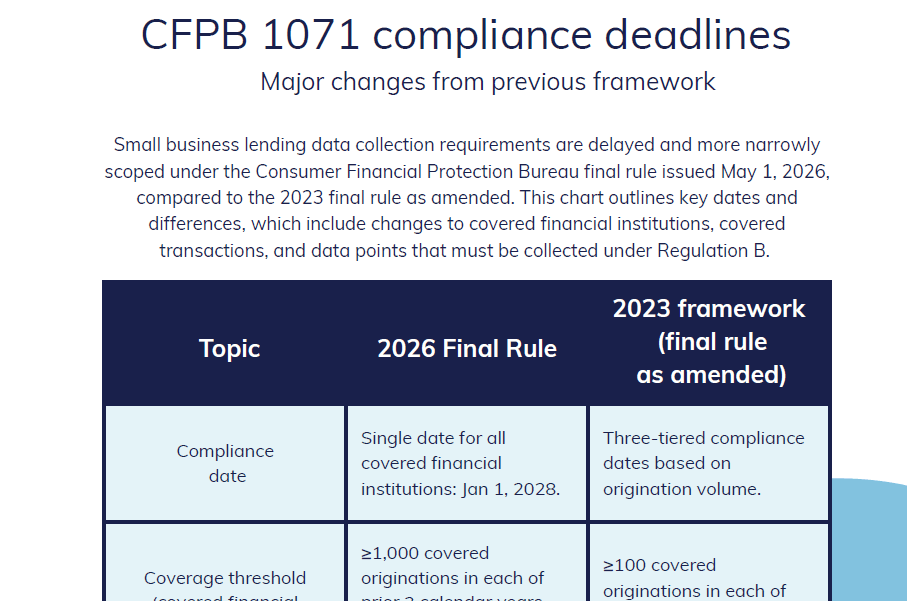
The Consumer Financial Protection Bureau (CFPB) in 2026 issued a final 1071 rule that extends the section 1071 compliance date for all covered financial institutions to Jan. 1, 2028. The new rule for collecting data on small business loan activities replaces a 2023 rule framework and its tiered implementation deadlines.

You might also like this one-page PDF with key dates and details on complying with the 1071 rule.


Image of resource on CFPB 1071 deadlines & dates

DOWNLOAD

This post was updated to reflect new compliance deadlines finalized by the CFPB on May 1, 2026. 

Final rule

Effective dates & compliance dates for rule 1071

As they do with any new requirement, financial institutions want to know when the CFPB 1071 rule is effective and when they must begin collecting and reporting data on their small business lending activities.

The effective date of the Consumer Financial Protection Bureau’s (CFPB) new rule was August 29, 2023.

However, the CFPB recently finalized later deadlines for compliance and reporting the data collected about small business loan applications. With an initial compliance due date of Jan. 1, 2028, for all covered financial institutions, lenders with higher volumes of originations should begin preparing now.

The CFPB’s small business data collection rule implementing Dodd-Frank 1071 has gone through many iterations in recent years. Court cases and changes to the rule have delayed compliance dates numerous times, in much the same way compliance with the current expected credit loss (CECL) model was delayed by several actions.

In the case of 1071, the CFPB in 2025 undertook a comprehensive review of the rule and finalized its changes on May 1, 2026, so financial institutions now have a clearer picture of deadlines and requirements.

Lenders should continue to monitor ongoing regulatory and legislative efforts to revise collection and reporting deadlines and requirements. But for now, the new 1071 compliance and reporting deadlines are as follows:


Type of 1071 deadlineDeadline
Data collection efforts must beginJanuary 1, 2028
Report data to CFPBJune 1, 2029

Source: CFPB


How to stay ahead of compliance

Despite the seemingly long runway to prepare, it's not too early to get a handle on the new requirements and how they will affect a bank or credit union. With the changes, many financial institutions face the most significant data collection and reporting effort in nearly 50 years. Given this scope, lenders need to begin assessing now how and when they will comply.

In addition, the CFPB has made it clear it may expand 1071 reporting requirements over time, so smaller-volume lenders will want to monitor 1071 rule developments. The final rule described that the bureau is taking an incremental approach to “better serve the statutory purposes of section 1071 in the long term.” It said:

“Such an approach will start with core lending products, core providers, and core data points….Over time, as the Bureau and financial institutions learn from early iterations of data collections, the Bureau could consider amending the rule.”

Abrigo has helped thousands of bank and credit union staff members learn more about 1071 and how to prepare for it through educational webinars, podcasts, and whitepapers. The company, which provides lending and compliance solutions to more than 2,400 financial institutions, has 1071 lender resources to help financial institutions capture small business loan data, store it, and report it to the CFPB to comply with the required timelines.

CFPB 1071 resources include Abrigo's small business loan origination software for automating 1071 data collection and reporting. It has built-in data firewalls and permissioning features that allow covered financial institutions to collect the required data and file it with the CFPB in compliance with the new rule. Abrigo's 1071 reporting capabilities mean banks and credit unions can collect all required data fields in a borrower-facing form, access pre-built reports, and easily enforce firewall requirements to limit access to 1071 personal data.

Below are important details on 1071 compliance, including which financial institutions must comply, what the changes involve, and important 1071 compliance dates.

Fair lending regulations

What are the goals of 1071?

Before discussing 1071 compliance dates and detailed requirements, it’s helpful to understand the rule’s goals and which financial institutions it affects.

The final rule implements section 1071 of the Dodd-Frank Act by amending the Equal Credit Opportunity Act (ECOA), or Regulation B (Reg B). The CFPB small business lending data collection regulations are being included as subpart B of Reg B and aim to support and enforce the fair lending requirements. CFPB intends the data collected by lenders on each small business credit application to facilitate enforcement of fair lending laws, especially those related to minority-owned and women-owned small businesses. Reporting on the data is also expected to help creditors, communities, and governmental entities identify small business owners’ needs and credit opportunities.

While the 2023 final rule for small business lending data collection meant lenders would have to collect more than 80 pieces of data per application, the 2026 final rule has streamlined collection and reporting. This final rule removes the discretionary data points for application method, denial reasons, pricing information, and number of workers from the prior rule's requirements. It also narrows the reporting categories for race, ethnicity, and sex of principal owners, and eliminates the need to determine LGBTQ+ ownership status.

Covered lenders & credit types

Which lenders are "covered financial institutions" in the 1071 rule?

The rule outlines that any company or organization engaged in lending activities may be covered by the requirements. Farm Credit System lenders and motor vehicle dealers are excluded, but banks, credit unions, savings associations, online lenders, commercial finance companies, non-profit lenders, and government lenders are among those that will need to determine whether they meet the origination threshold for compliance.

To be subject to the rule’s requirements at all (i.e., to be considered a “covered financial institution”), a company or organization must have originated at least 1,000 covered credit transactions in each of the preceding two calendar years.

Institutions can use origination counts from either 2026 and 2027 or from 2025 and 2026 for the initial determination of whether it is a covered financial institution. Institutions that aren’t covered initially are required to begin tracking and reporting the small business lending data once they meet the threshold of 1,000 covered originations in two preceding calendar years.

What is a covered transaction

The CFPB generally describes it as a request for any of the following:

  • loans
  • lines of credit
  • credit cards

One change from the 2023 rule is that the 2026 final rule excludes from the list of covered transactions the following:

  • merchant cash advances (MCAs)
  • agricultural lending
  • loans of $1,000 or less.

That $1,000 threshhold will be adjusted for inflation every five years.

For purposes of determining whether a financial institution is covered by the rule, requests for additional credit on an existing loan are not counted as originations. They are, however, covered transactions as they relate to tracking data for small business loan applications by covered financial institutions.

Defining "application" for a covered transaction

For data collection and reporting, financial institutions must track applications they receive for covered transactions, as opposed to solely tracking originations. What is an application under the CFPB 1071 rule? It is an oral or written request for a covered credit transaction that is made following the procedures used by a financial institution for the type of credit requested. This means that lenders must track data not only related to approved and booked credit but also applications that are for more than $1,000 in credit and are any of the following:

  • withdrawn
  • incomplete
  • denied
  • approved by the lender but not accepted by the applicant

Would you like to stay up to date on CFPB 1071 implementation?

A re-evaluation, extension, or renewal request on an existing business account is excluded from the definition of covered applications as long as the request seeks no additional credit. Inquiries and prequalification requests are also excluded.

Excluded small business credit types

Which credit transactions are excluded from 1071?

As noted earlier, in addition to loans under $1,000, the final rule excludes merchant cash advances and agricultural lending from the list of reportable transactions. Other types of transactions excluded from the CFPB’s requirements to report on applications include:

  • trade credit
  • public utilities credit
  • securities credit 
  • incidental credit
  • insurance-premium financing
  • factoring 
  • leases
  • consumer-designated credit used for business/ag purposes, such as taking out a home equity line of credit or charging business expenses on their personal credit cards
  • purchases of originated covered credit transactions 
  • applications with potential HMDA and section 1071 overlap: CFPB does not require reporting under section 1071 (transactions would only be reportable under HMDA)

A final component of the rule that is useful in understanding the various deadlines for 1071 reporting is the CFPB’s description of what constitutes a small business. An applicant or borrower is considered a small business if it had $1 million or less in gross annual revenue for its preceding fiscal year before applying. That threshold was lowered from the earlier rule framework’s definition of $5 million in annual revenue.

Abrigo can help you navigate 1071 deadlines and compliance. In addition to our 1071 resource page for lenders, which has updated information to help prepare for the new requirements, Abrigo’s Loan Origination Software already has all required data fields in a borrower-facing collection form, access to pre-built reports, and the ability to export for CFPB reporting. Your financial institution can comply with 1071 while streamlining the origination process and ongoing customer management by working with a trusted partner of 2,400 institutions. Talk to a specialist to learn more.

About the Author

Mary Ellen Biery

Senior Strategist & Content Manager
Mary Ellen Biery is Senior Strategist & Content Manager at Abrigo, where she works with advisors and other experts to develop whitepapers, original research, and other resources that help financial institutions drive growth and manage risk. A former equities reporter for Dow Jones Newswires whose work has been published in

Full Bio

About Abrigo

Abrigo enables U.S. financial institutions to support their communities through technology that fights financial crime, grows loans and deposits, and optimizes risk. Abrigo's platform centralizes the institution's data, creates a digital user experience, ensures compliance, and delivers efficiency for scale and profitable growth.

Make Big Things Happen.